Introduction
Code review is one of the most critical yet time-consuming aspects of software development. Research consistently shows that thorough code reviews catch bugs, improve code quality, and prevent security vulnerabilities. Yet for development teams, code reviews represent a significant productivity drain—senior engineers spending 30 minutes to 2 hours per pull request, manually reading code, checking for style violations, identifying potential issues, and providing feedback.
For startups scaling engineering teams, this bottleneck becomes acute. Hiring more senior engineers to conduct reviews is expensive. Reducing review rigor compromises quality. Finding a middle ground has historically meant accepting incomplete reviews and missed issues.
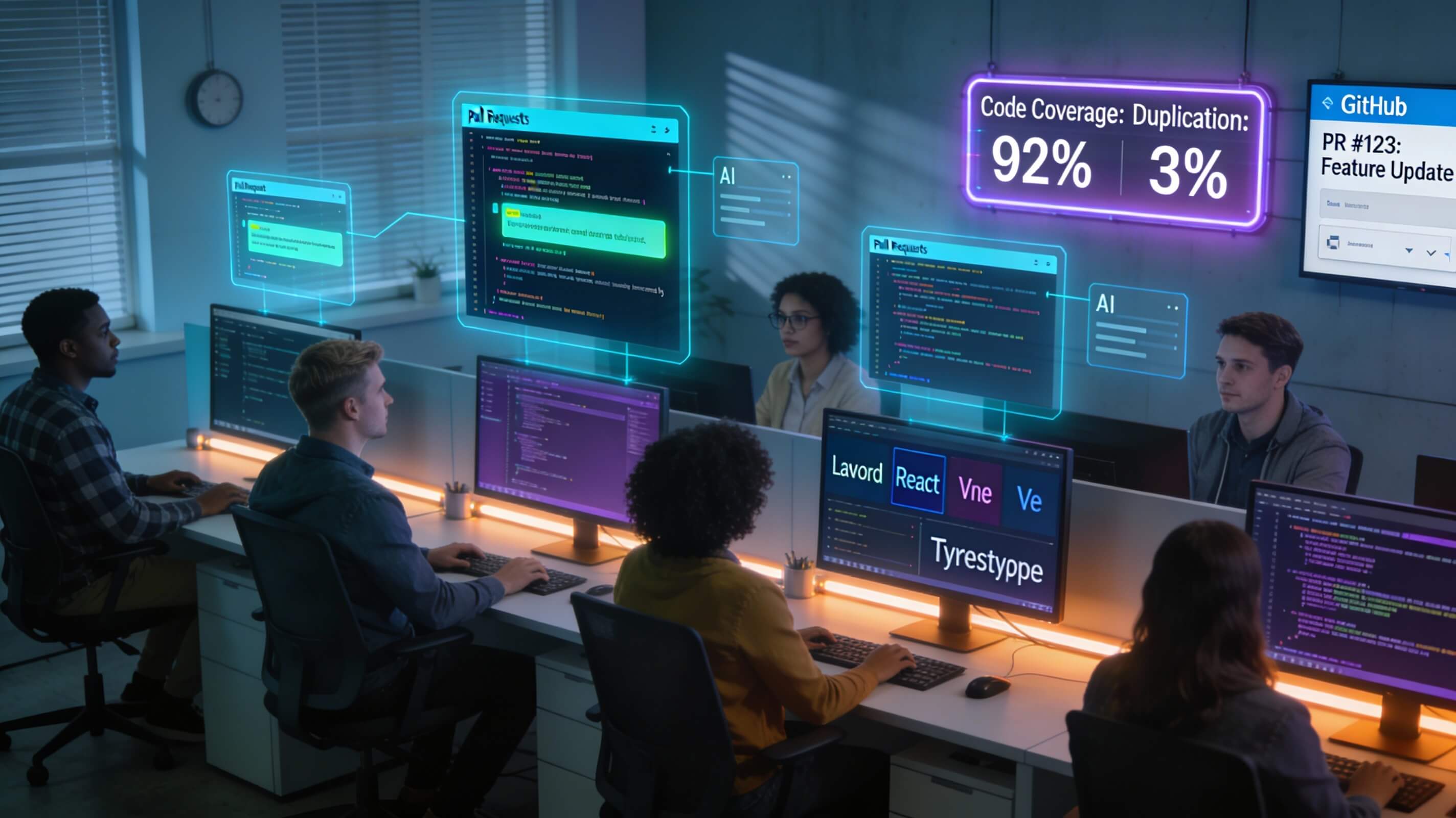
CodeSpect fundamentally changes this equation. By combining AI analysis with specialized models trained on framework-specific best practices—Laravel, React, Vue, JavaScript, TypeScript—the platform automates initial code review with human-like understanding, catching issues in seconds that would take senior engineers minutes to identify. For development teams, this represents a 50-70% reduction in review time with better issue detection.
The Code Review Bottleneck
Code review as a process is indispensable. Pull requests that bypass review accumulate technical debt, introduce subtle bugs that compound in production, and create inconsistent coding patterns across the codebase. Yet the traditional code review process—manual, synchronous, dependent on senior engineer availability—creates predictable bottlenecks:
- Time Waste: A single pull request consuming 30-60 minutes of a senior engineer's time is 30-60 minutes not spent on higher-impact work like architecture, strategic planning, or feature development.
- Context Switching: Code reviews interrupt flow state. Engineers context-switching between code review and feature development suffer 20-30% productivity penalties.
- Inconsistent Quality: Review quality varies based on reviewer attention, expertise, and availability. A junior engineer may miss edge cases a senior engineer would catch.
- Scaling Friction: Doubling team size doesn't double code review capacity (you can't just hire 2x engineers). Review becomes a bottleneck constraining team velocity.
- Missed Issues: Manual reviews miss subtle issues—N+1 queries, race conditions, security vulnerabilities—that automated analysis would catch consistently.
For startups with 10-50 engineers, this bottleneck can cost $500K-$2M annually in wasted senior engineer time. For teams prioritizing rapid iteration, review delays directly reduce market responsiveness.
What Makes CodeSpect Different
CodeSpect is built on three foundational capabilities that differentiate it from generic code analysis tools:
Specialized AI Models, Not Generic Ones
Rather than applying a general-purpose AI model to all code, CodeSpect uses pre-trained, specialized AI models optimized for specific frameworks and languages:
- Laravel-Specialized Model: Understands Laravel-specific patterns, Eloquent ORM best practices, service providers, middleware, facades, and Blade template conventions. Catches Laravel-specific issues like N+1 queries, improper service injection, and architectural antipatterns that generic models miss.
- React-Specialized Model: Understands React hooks conventions, component lifecycle patterns, state management best practices, and JSX patterns. Identifies component composition issues, hook dependency problems, and performance antipatterns specific to React.
- Vue-Specialized Model: Recognizes Vue 2 and Vue 3 conventions, composition API patterns, template directives, and lifecycle hooks. Catches Vue-specific issues that would be missed by generic JavaScript analyzers.
- JavaScript/TypeScript Models: Understand modern JavaScript ecosystem conventions, async/await patterns, type safety (TypeScript), and ES6+ syntax. Provide framework-agnostic feedback for general-purpose JavaScript and TypeScript.
- Fallback & Continuous Learning: For unsupported frameworks, CodeSpect uses a general-purpose model with automatic model upgrades as specialized models are trained for new frameworks (Python, Go, Rust, Java, C# in development).
GitHub-Native Integration with Zero Friction
CodeSpect integrates directly into the GitHub workflow—no new tools, no learning curve, no context switching:
- One-Click Setup: Connect repositories in 15 seconds. CodeSpect only requires read access to pull request content.
- Automatic PR Analysis: Every pull request is automatically analyzed. Feedback appears directly in GitHub's PR interface.
- Existing Workflow Preserved: Code review happens in GitHub where developers already work. No external dashboards, no emails, no context switching.
- Custom Rules Engine: Configure analysis rules that match your team's coding standards. Enforce specific patterns, ban certain approaches, or focus analysis on particular quality dimensions.
- No Code Storage: CodeSpect never stores your source code. All analysis is performed on-the-fly; data is not retained beyond the analysis session. This ensures security and compliance with IP policies.
Human-Like Understanding of Codebase Context
Unlike basic linters (which check syntax) or static analysis tools (which check rules), CodeSpect understands the semantic meaning of code:
- Intent Recognition: The AI understands what code is trying to do, not just what it says. This enables identification of logic errors, incorrect algorithms, and semantic issues that syntax checking misses.
- Best Practice Awareness: CodeSpect knows framework-specific best practices and architectural patterns. It can identify when code violates established conventions or introduces unnecessary complexity.
- Security Analysis: Identifies potential security vulnerabilities—SQL injection vectors, authentication bypasses, data exposure—with framework-specific context.
- Performance Analysis: Recognizes performance antipatterns—N+1 queries, unnecessary re-renders in React, inefficient loops—that would require manual analysis from performance-savvy engineers.
Core Features & Capabilities
- Automated PR Analysis: Every pull request is automatically analyzed. CodeSpect provides intelligent feedback directly in GitHub, covering code quality, potential issues, best practices, and security concerns.
- AI-Generated Summaries: Concise, contextual summaries of changes that capture developer intent and key modifications. These summaries save reviewers time in understanding PR scope.
- Framework-Specific Insights: Specialized feedback for Laravel, React, Vue, JavaScript, and TypeScript that recognizes framework patterns and conventions.
- Custom Rules Configuration: Define tailored analysis rules matching your team's coding standards, architectural patterns, and quality requirements. Enforce consistency across the codebase.
- Code Quality Tracking: Dashboard showing code quality trends across repositories and contributors. Identify improvement areas and track progress over time.
- Real-Time Feedback: Analysis results appear within seconds to minutes, enabling rapid iteration and quick PR merges for simple changes.
- Security Scanning: Identify potential security vulnerabilities, authentication issues, and data exposure risks with framework-specific context.
- Performance Analysis: Catch performance antipatterns before they reach production—N+1 queries, memory leaks, inefficient algorithms.
- Zero Data Retention: Your code is never stored. All analysis is performed on-the-fly with no persistent storage of sensitive information.
- Multiple Language Support: Specialized models for Laravel, React, Vue, JavaScript, and TypeScript. General-purpose model for other languages with planned expansion to Python, Go, Rust, Java, and C#.
Real-World Impact: How CodeSpect Transforms Development Teams
Time Savings & Velocity Improvement
Organizations implementing CodeSpect consistently report 50-70% reductions in code review time. A pull request that traditionally required 30-45 minutes of manual review now receives AI analysis in 2-5 minutes, followed by focused human review of remaining questions. The impact compounds: a team conducting 50 code reviews per week saves 15-25 hours weekly—equivalent to one full-time senior engineer freed for feature development.
Issue Detection & Code Quality
CodeSpect catches issues that human reviewers miss due to cognitive limitations, attention fatigue, or domain knowledge gaps. A Laravel team using CodeSpect reported discovering N+1 query problems, improper service injection patterns, and security issues that their manual reviews had consistently overlooked. The AI's consistency—never distracted, never fatigued—ensures thorough analysis on every PR.
Knowledge Codification & Team Leveling
Custom rules encode your team's knowledge and standards. Junior engineers receive feedback aligned with senior engineer expectations. Over time, developers internalizing CodeSpect feedback patterns improve code quality and architectural understanding, reducing the need for deep review feedback from senior engineers.
Security & Compliance
Security vulnerabilities are identified automatically—SQL injection vectors, authentication bypasses, improper secret handling. For regulated industries, CodeSpect provides systematic security analysis reducing compliance risk.
Practical Example: The Laravel Startup Scenario
Imagine you're a Series A Laravel startup with 15 engineers. Your current code review process:
- Three senior engineers each spend 15-20 hours per week on code reviews
- Total senior engineer time on review: 45-60 hours weekly
- Annual cost of review time: $117,000-$156,000 (at $50/hour loaded cost)
- Senior engineers often miss Laravel-specific issues (N+1 queries, improper service injection)
- Review delays occasionally block feature shipping
With CodeSpect:
- Every PR receives automatic AI analysis in 2-5 minutes with Laravel-specific feedback
- Senior engineers focus on semantic issues, architecture, and design—not syntax or obvious bugs
- Senior engineer time on review reduces to 5-10 hours weekly (60-75% reduction)
- Freed senior engineer time: 30-45 hours weekly (~$78,000-$117,000 annually)
- Improved issue detection; fewer bugs reach production
- Review delays eliminated; faster feature shipping
For a Series A startup, this is not a marginal productivity improvement—it's material business impact. Recapturing 30-45 hours of senior engineer time weekly accelerates feature development, reduces bug escape rates, and improves team morale (engineers prefer building to reviewing).
Pricing & Accessibility
CodeSpect offers flexible pricing designed for teams of all sizes:
- Free Plan (Lifetime): Perfect for trying out CodeSpect on small projects. Includes core AI code review features with generous limits. No credit card required; no expiration date.
- Starter Plan ($9/month): Designed for small teams and growing projects. Includes expanded repository limits and API access for integrations.
- Professional Plan (Custom Pricing): For growing teams and enterprises. Includes priority support, advanced customization, and high-volume analysis.
All paid plans include:
- Full access to specialized AI models
- Custom rules configuration
- Code quality tracking and dashboards
- Security and performance analysis
- GitHub-native integration
- Zero code storage; secure on-the-fly analysis
How to Get Started with CodeSpect
The workflow is intentionally simple—three steps to full implementation:
- Connect GitHub Repositories: Click "Connect GitHub" and select repositories to enable. CodeSpect only requires read access to pull request content. Setup takes 15 seconds.
- Optional: Configure Custom Rules: Define analysis rules matching your team's standards. This step is optional but recommended for mature teams.
- Start Receiving Feedback: Every new pull request is automatically analyzed. AI feedback appears directly in GitHub pull request comments within minutes.
That's it. No complex setup, no new tools to learn, no migration costs. Developers continue working in GitHub exactly as before—CodeSpect just adds AI analysis to the existing workflow.
Competitive Advantages for Engineering Leaders
Velocity Acceleration: 50-70% reduction in code review time means faster feature shipping without sacrificing code quality. This directly translates to market responsiveness and competitive advantage.
Quality Improvement: Consistent, systematic analysis catches issues humans miss—security vulnerabilities, performance problems, architectural inconsistencies. Fewer bugs reach production.
Senior Engineer Liberation: Freeing senior engineers from routine review work redirects their time toward architecture, mentorship, and strategic initiatives with higher ROI.
Scaling Without Hiring: Teams can scale feature velocity without proportionally scaling senior engineer headcount. You capture the benefits of code review without the cost burden.
Knowledge Codification: Custom rules encode best practices. Junior engineers receive consistent feedback aligned with team standards, improving overall team code quality.
Zero Migration Cost: Works within existing GitHub workflow. No new tools, no training, no process changes. Adoption friction is minimal.
Limitations & Realistic Expectations
While CodeSpect is powerful, understanding its constraints ensures optimal use:
- Not a Replacement for Human Review: CodeSpect handles ~70% of review work (basic issues, style, obvious bugs). Complex architectural decisions, design discussions, and nuanced code still benefit from human review.
- Framework-Specific Accuracy: Specialized models are more accurate than the general model. For unsupported frameworks, feedback quality is good but not as strong as framework-specific models.
- Context Understanding Limits: While advanced, the AI understands code context from the PR. Business logic external to the code (requirements, domain knowledge) still requires human understanding.
- False Positives Possible: Like all ML systems, CodeSpect occasionally flags non-issues. Custom rules help calibrate feedback to your standards.
Key Takeaways for Engineering Leaders
- Code Review Bottleneck Eliminated: Automate routine review work, freeing senior engineers for higher-impact activities.
- Velocity Improvement: 50-70% reduction in review time translates directly to faster feature shipping and competitive advantage.
- Code Quality Enhancement: Consistent, systematic analysis catches more issues than manual reviews, reducing production bugs.
- Team Morale Boost: Engineers prefer building to reviewing. Reducing review burden improves team satisfaction and retention.
- Scaling Enablement: Teams can expand feature velocity without proportional senior engineer hiring, improving unit economics.
- Security & Compliance: Systematic security analysis reduces vulnerability risk and supports compliance requirements.
- Minimal Adoption Friction: Zero migration cost; works within existing GitHub workflow. 15-second setup.
Conclusion
CodeSpect represents a critical inflection point in engineering productivity. For the first time, AI-powered code review with framework-specific understanding is accessible to teams of all sizes. The competitive advantage isn't in having code review—it's in having faster code review with better issue detection, enabling teams to ship features with higher quality and lower review overhead.
Whether you're a bootstrapped startup where every hour of senior engineer time matters, or a growth-stage company optimizing for scaling, CodeSpect addresses a material productivity bottleneck. The freed senior engineer time, improved code quality, and accelerated feature velocity compound into measurable business impact.
The engineering leaders who systematize code review with AI—maintaining human oversight while eliminating routine analysis—will outpace competitors still relying on manual, human-dependent review processes.
Ready to transform your code review process and accelerate engineering velocity? Share your developer tools startup idea on StartupIdeasAI.com to connect with investors, collaborators, and innovators building the future of development tools.