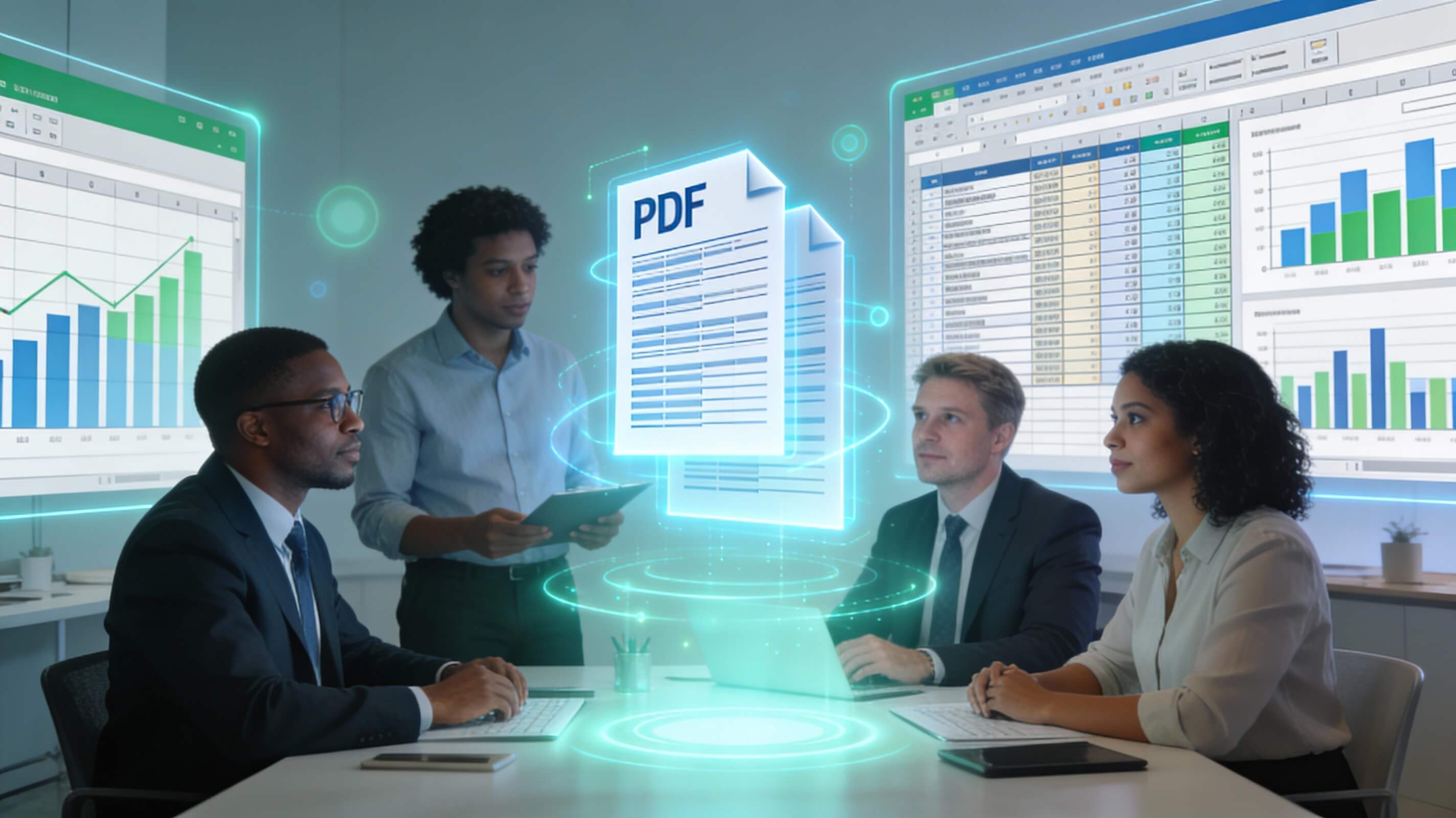
Introduction: The Problem With Manual Bank Statement Processing
Every accountant knows the frustration. A client sends a stack of bank statements in PDF format—sometimes scanned, sometimes poorly formatted. Your team then faces hours of manual data entry: copying transaction dates, amounts, vendor names, and descriptions into spreadsheets. One typo cascades into reconciliation nightmares and audit delays.
This inefficiency isn't unique to small practices. According to fintech research, 76% of financial services companies have launched AI initiatives specifically to reduce the manual burden of document processing. Yet many organizations still rely on manual workflows for bank statement digitization, leaving money on the table in the form of wasted labor hours and increased error rates.
Enter Bank Statement Converter AI, an emerging SaaS solution that automates bank statement digitization with enterprise-grade accuracy and privacy-first architecture. For founders, freelancers, accountants, and small business owners, this tool represents a tangible opportunity to reclaim hours of productive time and scale financial operations without proportional cost increases.
What Is Bank Statement Converter AI?
Bank Statement Converter AI is an intelligent document processing platform that converts unstructured PDF bank statements into clean, structured data formats—Excel, CSV, or Tally files. The platform uses:
- Advanced OCR (Optical Character Recognition) to decode text from scanned or digital PDFs
- Artificial Intelligence and Machine Learning to interpret context, validate data accuracy, and flag anomalies
- Zero-retention architecture where files are automatically deleted after processing, ensuring privacy compliance
The tool achieves 99.9% accuracy in data extraction, handling diverse bank statement formats, currencies, and transaction types without requiring custom template configuration.
Key Features at a Glance
1. Multi-Format Conversion
- Converts PDF bank statements → Excel (.xlsx), CSV, or Tally formats
- Works with scanned documents, digital PDFs, and poor-quality images
- Handles statements from any bank or financial institution
2. AI-Powered Extraction
- Automatically parses transaction dates, amounts, descriptions, and account numbers
- Detects and flags duplicate transactions and anomalies
- No manual template configuration required—AI adapts to different statement formats
3. Privacy-First Architecture
- Zero data retention: Files are permanently deleted from servers after conversion
- Encrypted upload and processing
- No transaction history stored on servers
4. Speed and Scale
- Instant processing: Converts documents in seconds
- No batch processing delays
- Suitable for processing hundreds of statements monthly
Why Bank Statement Digitization Matters in 2025
Bank statement digitization isn't just a nice-to-have—it's becoming central to how modern financial operations scale. Three converging trends explain why:
1. The Rise of Embedded Finance and Automation
The embedded finance market is projected to grow from $85.8 billion in 2025 to $370.9 billion by 2035—a CAGR of 15.8%. This growth is driven by automation: companies are embedding financial services directly into their workflows, removing friction and manual handoffs. Bank statement digitization fits squarely into this trend.
2. AI-Powered Data Extraction Is Becoming Standard
Intelligent Document Processing (IDP)—which combines OCR, AI, and NLP—is now the gold standard. Organizations using AI-enhanced data extraction report 73% faster decision-making and save up to 3,100 hours annually per organization. Traditional OCR alone is no longer sufficient.
3. Regulatory Pressure and Data Privacy Are Non-Negotiable
With GDPR, CCPA, and evolving financial regulations, privacy compliance is now a competitive advantage. Bank Statement Converter AI's zero-retention architecture directly addresses this: accountants can digitize sensitive statements without worrying about data breach liability.
Who Benefits Most?
- Accountants and Bookkeepers: Eliminate manual data entry, accelerate reconciliation, reduce errors, scale without hiring additional staff
- Freelancers and Solopreneurs: Manage finances without hiring a bookkeeper, automate expense tracking and tax preparation
- Small Business Owners: Streamline AP/AR processes, improve cash flow visibility, reduce administrative workload
- Financial Institutions: Accelerate loan underwriting, automate KYC compliance, improve credit decisioning
- Fintech Companies: Bank statement extraction is foundational for embedded finance platforms and income verification
How It Compares to Alternatives
Bank Statement Converter AI occupies a sweet spot in the market:
| Aspect | Bank Statement Converter AI | Manual Data Entry | Generic OCR Tools | Enterprise IDP |
|---|---|---|---|---|
| Accuracy | 99.9% | 95-98% | 80-90% | 98-99% |
| Speed | Seconds | Hours | 1-2 min | Variable |
| Privacy | Zero retention | N/A | Varies (risky) | High, but data stored |
| Cost per Document | ~$0.50-2.00 | $5-15 (labor) | $0.10-0.50 | $1.00-5.00 |
| Setup Time | Zero | N/A | Varies | Weeks-months |
| For SMBs | Excellent | Poor | Good | Expensive |
Pricing Tiers
Bank Statement Converter AI uses a freemium model designed for solo practitioners and growing teams:
| Plan | Features | Cost |
|---|---|---|
| Anonymous | No signup; 1 page/24 hours | Free |
| Registered | Free signup; 5 pages/24 hours; history | Free |
| Subscriber | Unlimited conversions; advanced features; API access | Paid (tiered) |
Real-World Impact: Use Cases
Case 1: Accountant Scaling to 50+ Clients
A mid-sized accounting firm previously spent 4-6 hours weekly on manual bank statement data entry. After implementing Bank Statement Converter AI:
- Reduced manual entry time to <1 hour per week
- Improved accuracy, reducing reconciliation exceptions by 95%
- Freed up 200+ hours annually for high-value advisory work
- Increased billable capacity without hiring additional staff
Case 2: Solo Tax Consultant
A solo tax consultant previously struggled with international multi-currency statements. With Bank Statement Converter AI:
- Reduced tax prep time per client from 8 hours to 2 hours
- Handled 3x more clients during peak tax season
- Improved accuracy, reducing audit adjustments by 80%
Case 3: Fintech Startup Improving Loan Onboarding
A BNPL (Buy Now, Pay Later) platform used Bank Statement Converter AI to automate financial assessment:
- Reduced underwriting cycle from 5 days to 24 hours
- Improved credit decisioning accuracy by 25%
- Reduced cost per evaluation by 60%
The Broader Fintech Ecosystem
Bank statement conversion is a foundational capability for several fintech markets:
1. Open Banking and Financial Aggregation
APIs like Plaid and Finicity connect customer accounts. Bank statement conversion handles legacy documents and offline scenarios.
2. Embedded Finance and Credit Decisioning
Lenders rely on accurate financial data for creditworthiness assessment. Bank statement conversion provides structured input for ML models.
3. Accounts Payable and Expense Automation
Just as invoice automation transformed AP workflows, bank statement automation is streamlining cash flow reconciliation.
4. Compliance and Reporting
Financial institutions use automated extraction to satisfy KYC requirements, audit trails, and regulatory mandates.
Limitations and Considerations
- File Quality Dependency: Extremely poor scans or handwritten statements may require manual review
- Integration Limits: Current accounting software integrations are limited; API access is available on higher tiers
- Contextual Understanding: The tool extracts data fields but doesn't automatically categorize transactions (e.g., "Groceries" vs. "Utilities")
- Not a Full Solution: Not a replacement for full accounting automation, only the data extraction step
- Privacy Verification: Users should verify SOC 2 or ISO 27001 certification
Future Roadmap: What's Next
Near-Term (2026-2027)
- Direct integrations with QuickBooks, Xero, FreshBooks, Wave
- Real-time bank feed alternatives for institutions without API access
- Automatic expense categorization powered by machine learning
- Multi-currency reconciliation with real-time exchange rates
Medium-Term (2027-2028)
- Agentic AI: autonomous agents that reconcile accounts and flag discrepancies
- Predictive cash flow analysis based on historical patterns
- Automatic AML and KYC compliance flagging
Long-Term (2028+)
- Central Bank Digital Currency (CBDC) integration
- Blockchain-based audit trails for enhanced compliance
- Federated learning models for privacy-preserving AI
Getting Started: Step-by-Step Guide
Step 1: Choose Your Tier
Start with the Free Registered plan (5 pages/day). Upgrade if volume exceeds this.
Step 2: Set Up Workflows
Store converted files in cloud folders. Create templates in your accounting software for consistent imports.
Step 3: Validate Accuracy
Spot-check converted data against original PDFs. Document any format-specific quirks.
Step 4: Integrate Into Accounting Software
Use CSV/Excel imports to feed data into QuickBooks, Xero, or FreshBooks.
Step 5: Measure Impact
Track hours saved per client and calculate ROI based on hourly rates.
Why This Matters for Startup Founders
If you're building in fintech, accounting, or financial services, bank statement conversion should be on your radar:
- Foundational Capability: Automated bank statement extraction is a core requirement for lending platforms, accounting tools, and financial dashboards
- Defensible Moat: Accuracy and speed compound over time; tools that extract better and faster gain network effects
- Venture-Backable: The document automation market is well-funded (Rossum, Affinda, Veryfi have all raised significant capital)
- Unlocks Adjacent Markets: Bank statement conversion enables invoice automation, expense management, and cash flow forecasting
Conclusion
Manual bank statement processing is a relic of an earlier era of finance. The technology to automate it exists today, is affordable, and is proven to save time and reduce errors at scale.
Bank Statement Converter AI exemplifies this shift: a focused tool that solves a specific, painful problem for accountants, freelancers, and financial teams. Its zero-retention architecture addresses privacy concerns head-on, and its AI-powered extraction removes the guesswork from data quality.
For solo practitioners, the free tier provides immediate value. For growing teams, the subscriber plans unlock workflows that were previously impossible due to manual labor constraints.
If your workflows still involve manual bank statement data entry, it's time to upgrade.
Ready to eliminate manual bank statement data entry?
Try Bank Statement Converter AI Free — Start with 5 pages/day at no cost. No credit card required.
For startup founders and product teams: Share your startup idea on StartupIdeasAI.com to get discovered by investors and innovators building the future of financial infrastructure.